Friday, March 30, 2007

KALBE FARMA Announced 2006 Full Year Audited Results


PT Kalbe Farma Tbk. (“Kalbe”) today released financial results for the year ended December 31, 2006.

“Although we only managed to record a single digit sales growth this year, we are quite pleased with the performance because once again we had successfully beat the pharmaceutical industry growth,” said Johannes Setijono, CEO of Kalbe. “The year 2006 was an unusual year for the pharmaceutical industry in Indonesia. The industry usually performed a double digit growth every year but according to IMS, an independent research company which specialized in pharmaceutical information analysis, the market size of the industry (OTC + Prescription drugs) for 2006 has a year-on-year growth rate of -1.9. This figure can be further segregated into -5.7% growth for the Prescription drugs and 4% growth for the OTC drugs.”

This abnormality is mainly due to two macro-level incidents that happened during the year. The first incident is that the Government has decided to greatly reduce the amount of fuel subsidies it is giving to the Indonesians. This happened approximately in the month of October of 2005. As a result fuel price increased by an average 100%. This resulted in a significantly hampered consumer purchasing power especially to the people that belong in the middle to lower earnings segment that experienced the hardest hit.

But an even more disrupting effect came from the new Government regulation which was announced effective as of July 2006. Due to pressure coming from the Government, the association of local pharmaceutical producers decided to take a preemptive action to voluntarily lower the prices of 34 active pharmaceutical ingredients which defines to approximately 1,400 prescription product SKUs in the national market. The price decrease ranges from 10% to 70% of the original price. The deadline given for every pharmaceutical producers to reduce their prices was October 2006. Another regulation that was passed in the same year was the price reduction of certain unbranded generic drugs up to 50%.


YE Dec 31, 2006 Financial Highlights


Revenues - Kalbe reported revenue of IDR 6.07 trillion for the year ended in December 31, 2006, an increase of 3.42% compared to the previous year’s figure of IDR 5.87 trillion. Given the “not so good performance” year, the year 2006 was a meaningful year to Kalbe because this is commonly called ”The Restructuring Year” as the BOD has overtaken several projects that are aimed to successfully integrate the previous 2005 merger.

Prescription Revenues - Kalbe main business line, the Prescription Pharmaceutical Division, contribute 24% to the total consolidated sales. This division reported revenue of IDR 1.46 trillion, or 8% higher than the previous year’s performance. The main reason for this growth is that Kalbe has successfully completed its integration project to reorganize the marketing divisions within the whole group, coupled with the fact that Kalbe is not as deeply affected by the price reduction regulation. Therefore this rarely happening single digit growth from the division is well received by the Management because it is considered to be a rewarding experience if we compare ourselves to the rest of the companies in the Prescription Industry that performed an average of -5.7% year on year growth. This fact further supports how Kalbe became the number 1 player in the prescription industry with a market share of 10.6% as stated by IMS by the end of 2006. In the same statistics report, Kalbe ranked 3rd at the end of the previous year with a 9.4% market share.

Nutritional Revenues - Kalbe’s 2nd most important division is Nutritional Division which contribute 21.8%. The division is also not spared by the macro-level incidents but still manage to record sales of IDR 1.32 trillion, or 21.4% higher than the previous year’s figures. We believed that one of the reasons for this somewhat high growth is that Kalbe’s Nutritional Division mainly manufactures a generally higher priced products which are targeted towards the high income segment people which is not as greatly affected by the fuel price hike.

OTC Revenues - Kalbe’s OTC Division performed quite poorly this year if compared to the previous years. This division contribute 15.5% to the total consolidated sales; it recorded sales of IDR 1.32 trillion, or 3.8% lower than the previous year’s figures. Although the OTC is not as regulated as the Prescription industry, the Management believed that the reason for this is the macro-level incidents that was mentioned earlier in this document as well as a significant reduction of OTC products exports to Nigeria.

Energy Drink Revenues - Kalbe’s Energy Drink Division is very much affected by the reduced consumer purchasing power effect. This Division is currently contributing 14.8% to the total consolidated sales. It recorded sales of IDR 896 billion, or 8% lower versus 2005 figures. We believed that one of the main reasons for this minus growth is that Indonesia’s Energy Drink Industry performed poorly. The energy drink industry is also facing a fierce competition from non head to head competitors in other beverage category such as vitamin water. On the other hand, the exports of our energy drink products is doing relatively well, such as our exports to Philippines.

Distribution Revenues - Kalbe’s Distribution Division contribute 19.9% of total consolidated sales, it recorded sales of IDR 1.21 trillion, or 3.1% lower versus the previous year’s figures. This Division’s sales figures only take account sales generated from third parties’ products. The Management believed that the reason for this minus growth is that the previous year’s performance which is used as a benchmark with 2006, still include the sales of products from two principals that parted their ways with us in 2005.

Packaging Revenues - Kalbe’s Packaging Division contribute 4% of the total consolidated sales. It recorded sales of IDR 246 billion, or 5.8% higher than the previous year. This Division’s sales figures only take account sales generated from providing packaging service to third parties’. The Management believed that the reason for this slow growth is that while the fuel price hikes significantly increased their costs. The industry itself is experiencing a slowdown mainly due to the slower economic consumption for the year.

Gross profit - Gross profit is recorded at IDR 3.1 trillion which is 4.57% higher than the previous year’s. At the same time gross profit margin increased from 50.47% of Net Sales last year to become 51.04% of Net Sales this year. This is due to the favorable and stable US Dollar exchange rate resulting in favorable cost of raw material that is mostly imported.

Operating expense - Operating expense increased by 6.52% versus the same period last year. The Company will further make utmost efforts to minimize its expenses particularly its selling expenses so as to be in proportion with its sales growth towards the year end.

Operating Profit - Operating Profit reached IDR 1.07 trillion which is 1.06% higher than the previous year’s restated figures which was IDR 1.06 trillion. Operating profit ratio decreased from 18.06% of Net Sales to become 17.64% of Net Sales this year.

Net Profit - However, the Company posted net profit of IDR 677 billion; or 8.06% higher than 2005’s restated figure of IDR 626 billion. The growth is mainly contributed by the decrease of interest expense and realized gain/loss of foreign currency exchange.

BAHASA


Wednesday, March 07, 2007

Kalbe Farma’s New Look, 6 March 2007


If you have accessed Kalbe’s website (http://www.kalbe.co.id) since 6 March 2007, you must have seen a different look compared to the days before. Starting with the logo, the web’s appearance also underwent a modification. This time Kalbe’s web looks more minimalist, informative and full with useful features. All these followed Kalbe’s new tag line, which is Life Enriching Science.


Front Page

The front page, which is usually called HOME is different with the previous one. The new look offers many conveniences. All the things that are frequently accessed by visitors are placed at the front page, namely: Annual report, Calendar of Event, Kalbe Offices (branch offices), Careers at Kalbe and Community are a group of articles under Kalbe’s web. All are Kalbe’s web characteristics that have been around all these time. Your first pit stop – to care for your health – and explore the Internet.


Additional Features: Health Consultation and My Kalbe

Several features were added or have their functions optimized, namely Health Consultation, which is a forum for health consultation. Users who want to ask will be asked to log in first.


Still Confused?

The web administrators urge the users to login every time they make a visit. Because when they are logged in (free sign up), users can personalized the web appearance. Any articles that are read frequently, can be placed at the front page and therefore it will look as minimalist as the user’s wished. Also, users can use other features as optimum as possible.

(Note: for Kalbe employees who already have a web-mail, there is no need to sign up. Please log-in using the given username and password).


Making a Better Life

All of these can make you feel more comfortable when you are browsing because we really care. With our new look that represents our care and attention for you, we are ready to give the best for all of you. We hold on to our commitment to keep dedicating science to enrich life.
With our new look, we are ready to step further into becoming a web with international standard in order to create a healthy and prosperous community.

Thursday, February 15, 2007

Kalbe Shares: Post Flooding Social Service February 2007


No less than 10 doctors with 40 nurses and volunteers from Kalbe Shares came to TNI AL Kodamar Complex, North Jakarta, Thursday, 15 February 2007. PT Kalbe Farma Tbk did this post-flooding social service in collaboration with MitraKeluargaHospital and TNI AL Marine Corps. The activities carried out including free post flooding treatment and the giving out of baby food.

Straight from the location, Dr Sujitno Fadli one of the medical team explained that there are about 545 patients that came for check ups. The community’s enthusiasm is very high. This could be seen during the time of registration that was suppose to be closed at 14.00 lasted much longer because there were so many people. The diseases mostly found were muscle pain, flu, skin diseases (eczema and daphnia) There were also people who still complain of having diarrhea as well as needing to have their wounds treated.

Besides the above activities, during this post-flooding time, Kalbe Farma also distributed medications such as Entrostop, Kalpanax, etc through 60 organizations and flood posts to areas that were flooded. “Besides distributing medications we also give out banner to remind people about the importance of cleanliness to keep diseases namely diarrhea and skin diseases at their minimum” explained Mr. Abdi Aydi Jaya of Kalbe Farma, as one of the event’s coordinators.

The activity is part of Kalbe Shares program which is a CSR project from PT Kalbe Farma Tbk that has been going on for a long time and being carried out continuously, covering aids in the field of education, health and facility repairs.
Kalbe hopes that these activities may contribute in building up the general community’s welfare.

Monday, January 08, 2007

Promag Received Indonesian Original Product Award 2006

The Indonesian Original Product 2006 Award held by the Indonesian Department of Trade and Harian Bisnis Indonesia, Indonesian business newspaper, Promag received the best Indonesian Original Product Award in the category of Over The Counter Medication.

Mari Elka Pangestu, the Indonesian Minister of Trade, attended the event.

The award is acknowledgement of Promag’s existence as a high quality local product with a powerful market competence and therefore becomes the first choice in the Indonesian community. The award also completes the range of other awards received by Promag namely ICSA (Indonesian Customer Satisfaction Award) 2000 -- 2006, IBBA (Indonesian Best Brand Award) 2004 -- 2006, as well as an award from IPRA (International Public Relation Association) - Indonesia 2006.

Tuesday, October 31, 2006

Kalbe Farma Grew By 1.41% in YTD September 2006


PT Kalbe Farma Tbk. (“Company”) today announced financial results for the quarter ended Sep 30, 2006.


Throughout the period of nine months of 2006, the Company sales performance has increased by 1.41% to Rp 4.49 trillion versus Rp 4.43 trillion last year.


Gross profit margin increased from 50.9% of Net Sales from last year to become 51% of Net Sales for the nine months period of 2006. This is due to the favorable and stable US Dollar exchange rate resulting in favorable cost of raw material that is mostly imported.


Operating expense increased by 5.27% compared to the same period last year. The Company will further make utmost efforts to minimize its expenses particularly its selling expenses so as to be in proportion with its sales growth towards the year end.


Operating Profit reached Rp 853 billion which is 4.11% lower than the previous year’s which was Rp 890 billion. Operating profit ratio decreased from 20.1% of Net Sales to become 19% of Net Sales this year.


However, the Company posted net profit of Rp 540 billion; 5.71% higher than 2005’s figure which was Rp 511 billion. The growth is mainly contributed by the increase in interest income, decrease in financial expenses and the reduction in foreign exchange loss.

Saturday, October 14, 2006

CORD BLOOD STORAGE, Now Available in Indonesia


There is no need to go to Singapore to store your baby’s cord blood - which is rich in stem cells because Indonesia will have its own “Cord Blood Storage” put together by CordLife Singapore in collaboration with PT Kalbe Farma. Stem cells that may be used for therapies of cancer, heart diseases, diabetes up to bone damage is not only useful for the owner of the cord blood but also his close relatives.

The cost is considered economical. The fee for cord blood extraction is 8 Million IDR. Storage fee is 1.2 Million IDR per year. Compare the fees with storing the cord blood in Singapore which could reach up to S$ 5.000 to S$ 10.000.

The construction plan for Cord Blood Storage in Indonesia is warmly welcomed by the Health Minister, Siti Fadillah Supardi. In the press conference held by PT Kalbe Farma, in Jakarta, Saturday (14/10), the Health Minister said with the increasing number of patients suffering from degenerative diseases and blood disorders, stem cell transplantation technology is inevitable.

“The realm of health education is developing and Indonesia cannot always be left behind. All these while, mothers who had just given birth have let their babies’ cord blood be taken away. They only know about the old myths of taking the piece of umbilical cord at home,” she said.

Dr Sunny Tan Chiok Ling from CordLife Singapore explained; during pregnancy, the umbilical cord is the only life connection between the mother and the baby. If all these times, umbilical cords are discarded and buried, in 1963, the medical world found that stem cells from this cord blood and umbilical cord may be used by the bay as well as his family to cure various diseases.

“This is because the blood in the umbilical cord contains millions of stem cells which can initiate the formation of blood type similar with stem cells found in the bone marrow. The stem cells in the bone marrow and cord blood have been successfully harnessed to cure many life threatening blood disorders,” he said.

The first stem cell transplantation was done in France in 1988 for a Fanconi anemia sufferer. At present there are already more than 3.000 stem cell transplantations and more than 72 diseases cured by it. Most of them are acute illnesses such as leukemia, non-Hodgkin's Lymphoma, aplastic anemia, and autoimmune diseases.
In the future, researchers believe that stem cell may be used to repair body organs such as heart and pancreas (diabetes), and help to treat diseases namely systemic lupus erythematosus (SLE), multiple sclerosis, stroke, alzheimer, and parkinson.
The interest of Indonesia’s community to store their children’s umbilical cord in a cord blood storage seems to increase. According to Yuliana Indriati from the Kalbe Farma Stem Cells Development Division, at the moment there are about 100 people in Indonesia who stored umbilical cords in CordLife Singapore. One of them is from the baby of Maya Rumantir.

“I see the community’s enthusiasm in Indonesia to store cord blood is pretty big. Seen from the requests of some patients in a number of hospitals in Jakarta. But, because the stem cord storage facilities in Indonesia is still under development stage, the storage is done in Singapore. The cost is more expensive, which is 12 Million IDR for extraction,” said Indriati.
The request for cord blood extraction procedure is done by the patient during pregnancy. At the time of delivery, the cord blood is left in the placenta, which is clamped and cut. Using a safe technique, the doctor will put the cord blood into a blood bag.
The process is safe and painless for both the mother and the baby.
“The blood bag method is a more sterile process and storage compared to other methods. Stem cells will be stored in liquid nitrogen container at – 196 degree Celsius. It enables the cells to be preserved safely. Stem cells may be used in the future when needed,” she said.
Questioned about the storage time limit, Indri said, it is unlimited, it depends on the client’s wish. Even though the stem cell is not used on the related child, it may be used for his family. “When used on close relatives, the rejection factor is very small because it has similar genetic characteristics,” she said. (Tri Wahyuni)

Wednesday, September 27, 2006

Leading Indonesian pharma company, Kalbe Farma, invests in CyGenics subsidiary, CordLife Indonesia

Leading tissue and cord blood banking company CyGenics Ltd. (ASX: CYN) today announced Indonesia's leading pharma company, Kalbe Farma, has taken a 49% stake in its cord blood banking subsidiary, CordLife Indonesia.

This is a further, important step in CyGenics strategy of focusing on its core business of tissue and cord blood banking, and greatly strengthens its presence in a large and important market in the Asian region. The expansion of the Indonesian operations is in line with CyGenics' focus on revenue generating cord blood banking services and on establishing a sound presence in all major markets in the Asian region.

Kalbe Farma is the largest publicly-listed pharmaceutical company in Southeast Asia, with a market capitalisation of approximately US$1.5 billion and US$600 million in revenue in 2005. Kalbe Farma has over 12,000 employees, which includes a sales force of 6,000 covering 80% of the Indonesian consumer health market. Further, it is the dominant supplier to the Indonesian prescription pharmaceutical market.

CordLife Indonesia has been in operation since December 2003. The cord blood units have been couriered to Singapore, for processing and storage at the company's AABB-accredited facility. The volume of business in Indonesia has grown to the extent that the operations now require a processing and storage facility in the country. The investment by Kalbe Farma will enable CordLife Indonesia to proceed with these plans. The new facility is expected to be fully operational by early 2007, and the company intends to seek AABB accreditation for this facility.

Kalbe Farma will make a significant contribution towards growing the business through its vast hospital sales force of 6,000 people, and extensive hospital and birthing centre network. CordLife Indonesia will launch an expanded marketing and sales program for the cord blood banking business later this year.

"We have been looking for some time for a suitable partner towards building a business around tissue banking and cell therapy solutions in Indonesia", said Boenjamin Setiawan, President Commissioner, Kalbe Farma. "CordLife has been operating in Indonesia for some time, with a good team of people and a strong reputation. The CyGenics group has the best expertise in this region in terms of operational experience in many markets, quality standards, and so on. I believe together we will be able to do great things and lift CordLife Indonesia to the next level of growth."

"With its close proximity to Singapore and a projected five million births in 2006 alone, Indonesia has always been a key market for future expansion for our CordLife operations," said Steven Fang, Group CEO, CyGenics. "We are pleased to welcome Kalbe Farma as a valuable partner, and we look forward to being able to reaching a great many more people with our cord blood banking service."

Thursday, September 21, 2006

Kalbe In-house Show & Pharma Forum 2006


Cheap Revolution influences all of daily life’s aspects. The pharmaceutical industry is no longer immune to this issue, as said by Johannes Setijono, the President Director of PT Kalbe Farma Tbk when opening Kalbe In-house Show & Pharma Forum 2006, Thursday 21 September 2006 at Cikarang, Bekasi Jawa Barat.


Cheap Revolution

According to Indonesia Innovator of the Year 2006 from CNBC Asia Pacific, Cheap Revolution is a massive event that occurred on account of globalization that overwhelms the world. Costumers are smarter in spending their money as well as increasing their demands for quality and comfort. As days passed the price for goods and services decline.

Some of the causes are: technology revolutions, real time media, the increase of productivity, price information from the internet, mass production, etc. Besides that, the pharmaceutical company in particular, is being demanded to reach a certain quality standard namely, cGMP, ISO 9001, ISO4001, OHSAS 18001 & Total Quality Management.

To achieve the above standards with high quality products and efficient cost, there is a way called Outsourcing.

Outsourcing system is commonly used by overseas companies – this benefits both parties. For the outsourcing contributor, this may decrease investments when there are new and high tech products in line. For the outsourcing recipients, the possessed capacity may be used to the maximum.

With outsourcing, the company may become tougher in facing cheap revolution. Slowly but surely, the products manufactured will become relatively cheaper, except the products that are still in patent period, said Johannes.

Can the "Local" manufactures survive without partnership?

The above question becomes the base of Santoso Oen’s explanation regarding the challenges in the world of pharmaceutical producer these days. As an example, the Director of PT Kalbe Farma Tbk quoted news regarding Vietnam’s pharmaceutical industry. Around 100 local pharmaceutical companies (out of 200) are at risk of being closed down. Some of the reasons are the increasing production costs and the demands from Vietnam’s National Agency of Drug and Food Control for higher quality. Such things may become an idea for the companies in Indonesia, both big and small to start thinking about production pattern that may depress the production and development costs, to hold back investment process cost and decrease quality management cost.


Besides taking up explanations from pharmaceutical outsourcing experts, participants can also look at the opened booths. Various booths that depicts the production process, quality control, supply chain management, packing, etc. were shown at Kalbe Farma office in Cikarang, Bekasi Jawa Barat.

Friday, August 11, 2006

Stem Cell Press Conference Symposium: New Hope in the Medical World


On 11 Augusts 2006, Medicastore participated in Stem Cell Press Conference Symposium which was held at the Anatomy Lecture Room FKUI by Fraunhofer Institute Germany working together with the University of Indonesia Medical Faculty and sponsored by PT Kalbe Farma, Tbk.

Speakers in attendance:
1. Prof. Dr. dr. M. Farid Aziz, SpOG (K), MRU FKUI Indonesia.
2. Dr. Johannes Bolze, Director and Principal Investigator Stroke Fraunhofer Institute German.
3. dr. Boenjamin Setiawan PhD, PT Kalbe Farma Tbk.
4. dr. Bambang Budi Siswanto, FIHA,. Vice Chairman of the Stem Cell Symposium Comittee

As moderators:
1. dr. Erik Tapan, MHA, Reflection of the Medical World
2. IBK Narayana Dr, Ing, Fraunhofer Representative Office Indonesia.

Hereon the detailed information:

Stem Cell = Miracle Cell
There are several diseases that are previously incurable by conventional therapies (chemotherapy and radiotherapy) such as multiple myeloma, chronic lymphatic leukemia, thalassemia major. Fortunately, now, there is a new hope.


In the last several years, there is a development in the medical world especially in the field of hematology and stem cell transplantation. “Stem Cell is the fifth phase in the medical history after the use of herbal and screening which continues to the discovery of cure for syphilis, the discovery of penicillin by Alexander Fleming and biotechnology,” said dr Boenyamin.


Stem Cell is a very unique cell because it has an amazing potential to develop and able to change into new cells or to become cells of other body organs. Stem cell has the assignment to repair abnormalities in the body and theoretically, stem cell may divide infinitely to fill other cells for the body as long as the person or animal still alive. When a Stem Cell divides or becomes other cell with more specific functions, such as muscle cell, red blood cell, brain cell, liver cell, kidney cell, etc.

The sources of Stem Cells are:
Stem cell from embryo (embryonal stem cells)Taken from an embryo in the blastoporic stage, the mass inside the cell grouped and contains embryonic stem cell. The cells are then isolated from the inside and cultured by in-vitro method. The stem cell will become specialized and then turn to be blood cells, muscle cells, liver cells and kidney cells.
Adult stem cells
One of them is hematopoietic stem cells. A stem cell that is able to create red blood cells, white blood cells and healthy blood platelets, usually found in bone marrows, periphery blood and umbilical cord blood.


“In America, a stem cell coming out from an embryo is banned by President Bush because it was considered as taking someone’s life. From 60 stem cells successfully created, in the US research unit, only 20 stem cell are still in function,” said dr. Boenyamin

Stem cells are found aplenty in the umbilical cords of newborn babies. That is why the blood from the umbilical cord can be stored and used when needed in the future. Even Korea, Thailand and Singapore have created facilities for umbilical cord blood storage. One of the banks for umbilical cord storage from newborn babies is Cordlife, Singapore. The storage costs S$2000 and there is an annual fee of S$200 for maintenance fee. “In Indonesia, the collecting of umbilical cords are available at RS Lippo Karawaci and RS Mitra Keluarga,” said Dr. Narayana.

Sources for stem cell transplant:
Family members or a donor with no family connection
Identical twins
Stem cell from the patient himself that has been stored beforehand


The Future in Indonesia
“In the medical world, especially medicine, Indonesia is above international standard,” said Dr. Narayana. Hence, initiated by PT. Kalbe Farma Tbk. Indonesia in collaboration with Fraunhofer Indonesia and several universities in Indonesia set up a group of stem cell research (ABG) with the support from the government through the Minister of Research and Technology.


Fraunhofer is a non-profit organization from Germany, which moves in the field of research and has 13.000 researchers made up of 500 professors and about 5.000-6.000 doctors. Fraunhofer’s main focus is to create a network between researchers and related institutes and henceforth found new businesses that supports research.“Fraunhofer has patented the stem cell culture and cell therapy, therefore it will act as a partner for the stem cell research in Indonesia,”verified Dr. Narayana.


ABG (Academicians, Business & Government) Is a stem cell research group made up of academicians, corporation and the government namely University of Indonesia, Bogor Institute of Agriculture, AtmajayaUniversity, PT Kalbe Farma Tbk. Lembaga Ilmu Pengetahuan Indonesia (LIPI) and Badan Penelitian dan Pengkajian Teknologi (BPPT). “The purpose of ABG is to create a focused coordination and collaboration in doing stem cell research in Indonesia, therefore it does not have to be done separately and the result could be use more effectively,” said dr.Boenyamin


The Universities are made up of educators and researchers with the hope that the research result may be enjoyed by the whole community. “The research costs may be supported by the Industry where the research may not only be used as a commodity but also reach the community,” explained Prof.Dr. Farid. Korea, UK, America and Germany pioneered the world’s stem cell research.


These three elements (academicians, business and government) will be thrown together to wipe out the stereotypes that have been formed in the community. The business stereotype is that they only look for profits, the academician stereotype is they only good for theory, but slow in practice and the government’s stereotype is that they complicate research with complex bureaucracy and very limited budget. In this case, the government is expected to be the catalyst of stem cell research in Indonesia and the Industry sector is hoped to be able to fund and even give incentive and therefore the whole Indonesian community may use the result. As comparison, other Asian countries have given high incentives for doctors who are doing stem cell research.


New Hope in the Medical World
In the human body, stem cell is usually concealed in the areas of bone marrow that are lack in oxygen. It is usually unveiled when the body suffers from an injury, and goes towards the injured areas. For example, it goes into the brain cell when the victim had a stroke, leukemia and so on. But stem cell can not help when stroke, leukemia or other diseases have become acute.

Stem cell is the new hope to cure diseases that are hard to treat. Stem cell therapy is also called cellular transplant. Stem cell may be specialized to become brain cells, heart cells, backbone marrow and other cells in the body. “First, the stem cell is cultured, for example, to be a heart cell and then the heart cell is harnessed and afterwards put into the heart through a catheter,” clarified dr.Bambang.

Stem cell has been proved to treat multiple myeloma chronic lymphatic leukemia, thalassemia major, heart miokard infarct, stroke, alzheimer, etc. Stem cell research team in Indonesia has targeted that Indonesia is able to create stem cell for stroke in the next 3-5 years. At the moment, the animal model has been developed.


Stem Cell Symposium

For more information regarding stem cell, and how to harness its potential in medical world, make sure to attend the stem cell symposium:

University of Indonesia Medical Faculty (Society Research and Dedication Manager) working together with PT. Kalbe Farma Tbk. and Journal Cermin Dunia Kedokteran (CDK) will organize a day symposium with the theme: Menyongsong Era Stem Cell di Indonesia (Greeting the Stem Cell Era in Indonesia) on Saturday, 2 September 2006 at the FKUI Hall


Registration at:

Redaksi majalah CDK (attn Dodi)

Gedung Enseval

Jl. Letjen Seprapto Kav.4

Telp:012-4208171, Fax: 012-42873685
Source in BAHASA http://www.medicastore.com

Now (2007), Indonesia has a Stem Cell and Cancer Institute
Address: Jl. Jend Ahmad Yani no. 2, Pulo Mas, Jakarta 13210 - Indonesia
Tel: +62 - 21 - 47860173

Wednesday, June 21, 2006

PT. Kalbe Farma Tbk. Annual General Meeting of Shareholders


In the year 2005, PT Kalbe Farma Tbk. (“the Company”) recorded net sales of Rp 5.87 trillion, which is an increase of 16.42% if compared to 2004’s figures. The growth is mainly contributed by the increase in volume sales of its health food’s products (Prenagen, Diabetasol, etc), gained market share of its energy drink (Extra Joss group), and volume sales of it’s OTC (Over The Counter) products (Promag, Mixagrip, Fatigon, Fatigon Spirit, etc).

The Company’s gross profit in 2005 was Rp 3.01 trillion. This is an increase of 22.91% if compared to the previous year’s figures. Noticeable improvement can be shown in the gross profit to net sales ratio; this has increased from 48.56% in 2004 to become 51.26% in 2005. The increase is mainly due to the continuous improvement effort by the Company to find areas of improvements in its production process so it can be more efficient. One such example is finding the right combination of product mix.

Marketing expenses in 2005 was Rp 1.55 trillion; this is 23.62% higher if compared to year 2004. Marketing expense to net sales ratio became 26.37% in 2005 from 24.84% in 2004. This is because of the increased effort in marketing effort to promote new as well as star products.

The Company recorded an increase in operating profit by 19.77% to become Rp 1.11 trillion from the previous year. This caused the operating profit to net sales ratio to increase from 18.32% to become 18.84%.

All these factors lead to an increased 2005 net profits of Rp 653 billion. This figure is 44.96% higher if compared to the figure in 2004. This growth can be achieved due to several reasons. Firstly, better performance in its overall operations. Secondly, interest rate was also higher on average in 2005 comparing to 2004. Finally, it is also due to the fact that Indonesian Rupiah strengthened considerably against United States Dollar.

The Company’s total asset value was Rp 4.73 trillion or an increase of 11.75% if compared to 2004. This is in line with the increased company size due to the merger which was effected on December 16, 2005.

  1. The Company’s Annual General Meeting of shareholders which was held on June 21, 2006 has resolved below matters as follows:
    1. To approve director’s annual accountability for the year ended on December 31, 2005 as well as to approve and ratify the company’s planning for year 2006;
    2. To approve and ratify the company’s yearly result for the year ended on December 31, 2005 which was audited by Public Accountant: Prasetio, Sarwoko & Sandjaja with its unqualified opinion, and to give full discharge of responsibility to the Board of Directors for their management and to the company’s Board of Commissioners for their supervision during the year ended on 31 December 2005 (acquit et de charge) as long as the results are reflected in the financial figures of Company’s yearly result for the year ended on 31 December 2005;
    3.
    a. To approve that there will be no cash dividend payout to all of Company’s shareholders;
    b. To approve that the net income in the amount of IDR 653,329,399,498 (six hundred fifty three billion three hundred twenty nine million three hundred ninety nine thousand four hundred ninety eight) is to be kept as an additional working capital for the Company;
    4.
    a. To approve the reappointment of the Board of Directors and the Board of Commissioners which will be effective starting the end of this annual general meeting of shareholders until the end of the 2008 annual general meeting of shareholders with the composition as follows:
    President Director : Johannes Setijono
    Vice President Director : Johanes Berchman Apik IbrahimVice President
    Director : Budi Dharma Wreksoatmodjo
    Director : Bernadette Ruth Irawati Setiady
    Director : Santoso Oen
    Director : Yozef Darmawan Angkasa
    Director : Vidjongtius
    Director : Herman Widjaja
    Director : Justian Sumardi
    President Commissioner : Boenjamin Setiawan
    Commissioner : Nina Gunawan
    Commissioner : Rustiyan Oen
    Independent Commissioner : Johannes Baptista Soemarlin
    Independent Commissioner : Inne Erna Adriana Soekaryo
    b. To give full authority to the meetings of the company’s Board of Commissioners to determine salary and incentive for member of Board of Commissioners and to give full authority to Board of Commissioners of the company to determine honorarium/salary for member of the company’s directors for year 2006;
    5. To give full authority to Board of Commissioners and/or Directors of the company to appoint Public Accountant listed in Capital Market Supervisory Body for auditing the company’s bookkeeping for year 2006, also to give authority to the company’s board of directors to determine their honorarium and other appointment requirements.

Source: Press Release No. 011/KFCP-DIR/PR/VI/06, dated Jun 21, 2006

BAHASA

Tuesday, June 20, 2006

PT Kalbe Farma Tbk was chosen as the Best Stock Issuer in Bisnis Indonesia Award Development Board


Attempts to be the best have to be done step by step. Whether the move is appropriate or not, we obviously need to do plenty of judgments and that inclues accepting judgments from outside parties. Recently, as published in Harian Bisnis Indonesia, Wednesday 21st June 2006, PT Kalbe Farma Tbk was chosen as the Best Stock Issuer in Bisnis Indonesia Award Development Board. Also, CEO of the Year 2006 went to Mr. Johannes Setijono, President Director of PT Kalbe Farma Tbk.

The Award was given on 20th June 2006 at Shangrila Hotel Jakarta
Sri Mulyani as the Minister of Finance stated in her opening speech that, ‘here, Asian companies are only a handful. Maybe only five (companies). I hope that the award may motivate more companies to compete in Asia.’

Bisnis Indonesia Award Winners 2006:

  • CEO of The Year: President Director of PT Kalbe Farma Tbk, Johannes Setijono
  • Best Development Board Issuer: PT Kalbe Farma Tbk
  • Best Main Board Issuer: PT Berlian Laju Tanker Tbk
  • Best Bank: PT Bank Rakyat Indonesia Tbk
  • Best Regional Development Bank: BPD Nusa Tenggara Timur
  • Best Mutual Funds: Fortis Investment
  • Most Active Security Company: PT Kim Eng Securities
  • Best Insurance (General) Company: PT Allianz Utama
  • Best Life Insurance Company: PT Sequis Life

The awards were given to urge and motivate market participants to improve and maintain their performances, 60% is based on finance load performance, 20% on corporate governance performance and 20% on corporate action performance. Particularly on corporate governance which performance is assessed based among others on: the distribution of share ownership and the level of management adherence towards law and regulations. While corporate action is based on positive activities toward the company.

Live Interview on TVRI, Friday 23rd February 2006, at 19.30 WIB
Do not miss the interview with Mr. Johannes Setijono as CEO of the Year 2006 as well as President Director of PT Kalbe Farma Tbk, the Best Stock Issuer in Bisnis Indonesia Award Development Board live from TVRI, Friday 23rd February 2006, at 19.30 WIB.

BAHASA

Wednesday, June 07, 2006

“MediFlex” Turnover Reached the Top 10 New Products in Indonesia


Mediflex, the first cream in Indonesia that contains glucosamine proves to be selling well. The cream meant for knee joint disorders is in the Top 10 New Products in Indonesia, according to the May edition of Farmacia Magazine. The definition of a new product is a product that has been launched in the last 2 years. It is in accordance with PT Kalbe Farma’s commitment to always innovate, launch (and to make it a success) new products.

Dr. Martinus Zega, Mediflex’s Product Manager affirmed that one of the keys that support the recognition of this 75gr cream is because the product is the first product in Indonesia that contains glucosamine. Another thing is because the packaging is designed to be as attractive as possible; hence, patients may know the indications or benefits of the cream. The point is still not common on medications sold as ethical drugs.

Even though it falls under the category if ethical products, the cream may be bought in pharmacies and hospitals without prescriptions. Also, the product has undergone clinical tests at Cipto Mangunkusumo Hospital Jakarta and proven to be effective.

According to the plan, after a success in Indonesia, PT Kalbe Farma Tbk will sell the product overseas.

Note
MediFlex TGC may be used to cure osteoarthritis and sport injury. MediFlex TGC is the first glucosamine cream in Indonesia. With TGC (Transdermal Glucosamine Cream) technology, hence glucosamine may penetrate the skin layer to reach the painful joint. The glucosamine level in the blood for the first 2 hours is a lot higher than oral glucosamine (administered by mouth), similarly after 6 hours. A topical application cause the chance of side effects occurring to be much smaller compared to oral administration especially one regarding gastro-intestinal problems.


The Top 10 New Products in IndonesiaAccording to Forbes, IMS Health, The Top Ten New top Products (<>

  1. Extra Joss, sachet 4gr
  2. Lipanthyl tab, 160 mg
  3. Prosogan tab, 30 mg
  4. Ezetrol tab, 10 mg
  5. Nexium vial dry, 40 mg
  6. Dexorubic in vial dry, 50 mg
  7. Mediflex cream, 75 g
  8. CDR tab eff. 10
  9. Hepsera tab 10 mg
  10. Iressa tab 250 mg

BAHASA

Sunday, April 16, 2006

Palonosetron (Paloxi) , a new anti-emetic drug from Kalbe Farma

Symposium “The 1st Tulip Oncology Summit 2006” with the topic of “From Basic to Clinic: Empowering Translational Research” was held at Sheraton Hotel Yogyakarta on April 15-16, 2006. There were around 400 participants who consist of oncologists, general physicians and medical students.
There were several interesting topics delivered, such as the new medicine Palonosetron introduced by Dr. Zakitman Jack, SpPD-HKOM and sponsored by PT. Kalbe Farma with the topic of “A Novel 5-HT3 Receptor Antagonist for Chemotherapy Induced Nausea and Vomiting”.

Hereby explained that nausea and vomiting from chemotherapy mostly is caused by the release of serotonin on the gastrointestinal mucosa, therefore the standard treatment for nausea and vomiting is based upon the serotonin antagonist. The anti-emetics from the class of serotonin antagonist which are currently available on the market do not have optimal effectivity. Therefore, PT Kalbe Farma marketed the most recent anti-emetic of serotonin antagonist class called Palonosetron. There are several advantages of Palonosetron from its pharmacological side, which has longer half life (up to 40 hours) therefore only needed once on the first day of chemotherapy with the effectivity up to days 5 and 6. Thus this can prevent the occurrence of nausea and vomiting acutely for the first 24 hours after chemotherapy up to 120 hours afterwards.
On the clinical trial phase III, Palonosetron 0.25mg compared with other serotonin antagonist such as Ondansetron and Dolasetron on the standard dose, Palonosetron has similar effectivity equal to those two drugs to prevent the side effects of nausea and vomiting within the first 24 hours. However, it is more effective after the first 24 hours of chemotherapy up to day 5 preventing the moderate and high emetogenic effect of chemotherapy.
In Indonesia, Palonosetron will launch soon with brand name: Paloxi

Thursday, April 13, 2006

Media Workshop & Testimonial Book Launch PROMAG MULIA


Welfare deterioration of lower socio-economic status community and the success of pioneer PROMAG MULIA Program (2005) underlie PT Kalbe Farma Tbk to keep instituting amateur entrepreneurship trainings in 6 cities (Jakarta, Bandung, Surabaya, Makassar, Medan and Lampung). These trainings provide professional entrepreneurship knowledge of the ManagementQolbuTrainingCenter whose chair is KH Abdullah Gymnastiar from Darul Tauhid Bandung. This is the news of press release together with the Testimonial Book Launch titled “Jangan Jadi Pengusaha Bila Tidak Berani Memulai (Don’t Be An Entrepreneur If You Don’t Dare To Start)” in JakartaApril 13, 2006.
(picture: Mr Johannes Setijono with Aa Gym)

The pioneer PROMAG MULIA Program (Membangun Usaha Lewat Ilmu dan Ahklak/Establishing Business With Knowledge and Morality) attracted 20 participants from 5 cities. This exhibited the enthusiasm and expertise, furthermore motivating a book to be written, titled “Jangan Jadi Pengusaha Bila Tidak Berani Memulai” (Don’t Be An Entrepreneur If You Don’t Dare To Start). This book is a consolidation of experiences and tips to be shared by the participants for the community. This book can be obtained at the bookstores which sell Aa Gym books.

Mr. Johannes Setijono as the President Director of PT Kalbe Farma Tbk stated that: “We cannot imagine how many amateur entrepreneurs who try to build their own business independently and how big their success contributes to the Indonesian economy and welfare. Therefore, PROMAG MULIA intends to help to expand their businesses until they become durable and competitive professional entrepreneurs. With the provided assistance given, hopefully the number of entrepreneurs will be increasing year-by-year”.

This program is aimed for amateur entrepreneurs from B, C and D class with the age range of 18-30 years old, healthy, have their own business, passed the test and interview which were held in several cities.

KH Abdullah Gymnastiar (Aa Gym) as the chair of “Management QolbuTrainingCenter” stated that “Success is not something for granted but have to be earned with enthusiasm. Only entrepreneurs with good morality will be a great leader, and if there are more people with good morality then this nation will be a great nation”.

The training packages provided by PROMAG MULIA program was compiled by MQ. It is very concentrated so it requires prime health of the participants. In order to understand the allocated program, at the event of April 13, 2006, several journalists were invited to participate on the events which are held frequently by PROMAG MULIA. After this event, there were books distribution with the autograph of Mr. Johannes and Aa Gym.

PIRA Indonesian Award 2006
Recently PROMAG MULIA program won International Public Relation Association / PIRA-Indonesian Award 2006 as the best CSR Programme (Corporate Social Responsibility Programme).

- Official website, http://www.promagmulia.com/

BAHASA

Tuesday, January 24, 2006

DETAK, Early Cancer Detection Program approved by Indonesian Health Minister at Jakarta January 24, 2006.

According to histopathology examination in Indonesia on 1999, five leading site of cancer predominant in Indonesian population are cervical cancer, lymphoma, breast cancer, skin cancer and colon cancer. Arising from that awareness, Kalbe Farma cooperating with Dharmais Cancer Hospital launched DETAK (Deteksi Awal Kanker) or Early Cancer Detection Program.

DETAK was launched after being approved by Indonesian Health Minister, Dr. Siti Fadilah Supari, SpJP (K) at Gedung Dharma Wanita Pusat Kuningan, Jakarta on January 24, 2006. This event was followed by seminar, press conference and distribution of the book titled “Kanker, Antioksidan dan Terapi Komplementer” also some brochures.


(In the picture above from right to left: Herman Widjaja, Sutoto, Mrs. Umar Wirahadikusumah and Adji Baroto at the press conference. Click to enlarge)


Background

The background of launching this program is because cancer often being identified very late. This was attributed by fear of cancer in the common population which made people feel reluctant for examinations. Late diagnosis in the end inflicts with the rising health care cost, and decreasing the patient’s life-expectancy.
Aware with the importance of early screening, Yayasan Kanker Indonesia, Dharmais Cancer Hospital Jakarta and PT Kalbe Farma Tbk, endorsed mutual commitment to start enforcing DETAK program on November 2005.
DETAK is an educational program for the community to increase the knowledge about cancer, designed to convert the fear as to concern of cancer. This program is considered to be successful if the community already has courage to do routine medical check-up for earlier cancer screening.
DETAK program will be applied within one year by the following programs:
• Public seminars about cancer
• Press conferences
• Symposiums on cancer for journalists
• Writing contests about cancer
• Educational materials distribution such as: poster, brochure, etc
• Public and group lectures about cancer

With the strength and power of each participating side, Mr. Herman Widjaja as Kalbe Farma Director is optimist that this program will succeed. Kalbe Farma which has about 60 branches nationwide in Indonesia, is ready to support this noble program fully.
(Alongside with online electronic media such as this Kalbe Farma website)

DETAK secretariat
Jl. Swadaya Raya no. 11A, Duren Sawit Jakarta 13440
Tel.: 021-862 8557, 021-862 8584
Fax: 021-862 8584
E-mail: cakrawara@indo.net.id
Website: http://www.detak.org

BAHASA

Thursday, December 08, 2005

President Commissioner PT Kalbe Farma, Boenyamin Setiawan received Lifetime Achievement Entrepreneur of The Year 2005


Boenjamin Setiawan, widely known as Dr. Boen, has an academic background in both pharmacology and pharmakinetics. He was awarded his PhD in pharmacology in 1961 in the USA. On his return to Indonesia he established a pharmaceutical business working from his own garage and partnering with his siblings who were also active in the medical field.
The success of the Kalbe Farma group under Dr. Boen's leadership has been founded on the local production of cheap generic ethical drugs to meet the economic and health needs of Indonesian people. The strategy is supplemented with alliances with overseas principles and a strong focus on research and development. New product lines have been steadily introduced and international markets developed in Asia and Africa. From very humble beginnings over 30 years ago, the Kalbe Farma group is now the largest pharmaceutical group in Indonesia with over 6000 employees. Around him, Dr. Boen has built a strong management team including his siblings and second generation.

He also enjoys the support and trust of the community, as can be seen from the many social, educational and civic organizations in which he holds key positions and responsibilities, past and present, most notably as Board Member of KOMNAS Lansia, Advisory Board Member of GP Farmasi, Advisory Board Member of KOMNAS Perempuan, Financial Advisor of Yayasan KEHATI, and Treasurer and one of the founders of Yayasan Pengembangan Kreativitas Indonesia. Despite his busy schedule overseeing the operations of the Kalbe Group, he finds time for community services through these organizations and remains active in the Faculty of Pharmacology of the University of Indonesia, where he passes his extensive knowledge in the pharmacology science to his students and colleagues.

Source
http://www.ey.com/GLOBAL/content.nsf/Indonesia/EoY_2005_-_Award_Recipients#Boenjamin_Setiawan

Tuesday, December 06, 2005

Great News for CAPD ASKES Users in Indonesia

Until now, patients with kidney failure can be managed with Hemodialysis, CAPD and kidney transplant. Among those 3 methods, CAPD (Continuous Ambulatory Peritoneal Dialysis) is currently a hot topic between Asian Nephrologists including Indonesia. This was expressed by Dr. Ginova Nainggolan, SpPD KGH in the Indonesia Nephrology Pre-congress Program on Thursday, November 24th, 2005 in Bali.

In the workshop, CAPD was discussed by speakers such as Prof. DR.Dr. Moch. Sja'bani, SppD KGH MSc, Dr. Tunggul D Situmorang SppD KGH and Prof. DR.Dr. Endang Susalit, SpPD KGH, Dr. Tommy Halauet, SpB.

Dr. Tunggul said, CAPD is very helpful in patients with kidney failure who have to undergo Hemodialysis. The advantage of CAPD is, the patients do not have to use the dialysis machine and may use it by themselves at home. Another advantages are they would have better physical conditions, may exercise as usual and their diet would not be as strict as when they are undergoing hemodialysis.

CAPD has been used in Indonesia since 1984, and according to Prof. Sja'bani at the moment, there are quite a lot of kidney failure patients in Indonesia, and most are from the 3rd class patients (poor people). The government is liable to manage the cost of CAPD through PT ASKES (goverment health assurance), especially for GAKIN (poor people).

In front of 150 participants, Dr. Ita Wijayanti from Kalbe Farma as a speaker explained the usage and function of instruments used in CAPD and the advantage of instruments produced by Baxter - Kalbe, one of them is the diminution of sepsis or peritonitis occurring.


Great News

There is a great news for CAPD Baxter – Kalbe Farma user or users to be, especially ASKES members:

  • Free Starter Pack (this particular one has always been free)
  • Free for Routine Pack 90 (formerly, participants have to pay Rp. 600.000)
  • Only with an additional fee of Rp. 1.033.000 for Routine Pack 120 (a decrease from Rp. 1.600.000)
  • The above regulations start October 2005.

Thursday, November 24, 2005

Circular Leter Merger Proposal PT Dankos Laboratories Tbk. and PT Enseval into PT KALBE FARMA Tbk.

In relation to the Merger plan, the Board of Directors of the Merger Participants hereby present this Merger Proposal for information to shareholders of each of the Merger Participants, creditors of each of the Merger Participants as well as other relevant parties to the Merger in order to obtain approval from the EGMOS of each Merger Participant to be held on 29 November 2005.


For more information regarding this merger plan, you can click the address below: http://www.kalbefarma.com/files/investor/CircularKalbe.pdf (510 kb)

Wednesday, October 26, 2005

Promag Double Action, coming soon !!!

As the leader of gastric medication market share in Indonesia (80%), Promag as one of PT Kalbe Farma Tbk brands, does not just sit back, but keep on developing new innovations. Last but not least, PT Kalbe Farma (JSX: KLBF) will launch new variant of Promag, intended for its premium segment.

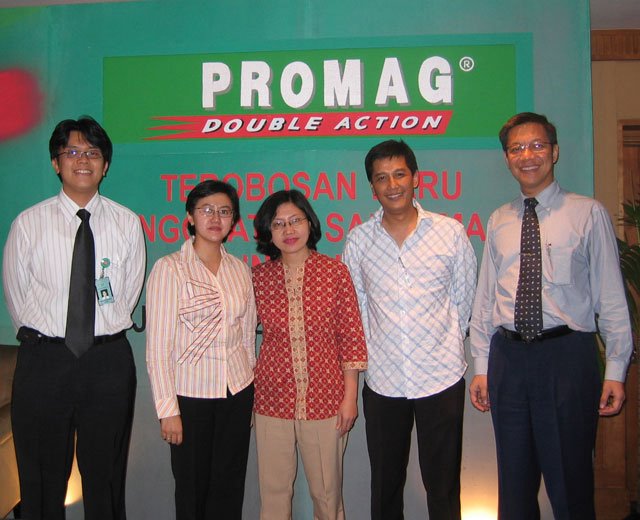
Promag Double Action works in two-way approach in gastric management. It is the first OTC combine drug in Indonesia, Antacid and Acid Blocker.

In the picture taken after the press conference, from left to right: Rully Prasetyanto (Product Executive), Sinteisa Sunarjo (Group Product Manager), Eliana Taufik (Internist), Mayong Laksono (Moderator), Djoni Hartono (Assistant Director OTC).

According to Eliana, an internist, gastric pains in medical terms is called Dyspepsia Syndrome. Its symptoms are: pain, nausea and even vomiting.


The causes can be divided into two:

  1. Organic such as: the presence of stomach ulcer, etc
  2. Functional such as: the increase of stomach acid and stomach sensitivity even though the stomach acid remains unchanged, etc.
The gastric pain management itself starts from the diet, a change in lifestyle up to the consumption of medications.

Up to the moment, the circulating Over The Counter drugs are antacids. The function of antacids is to neutralize stomach acid.


Promag Double Action

Promag Double Action works 2 ways, it neutralises and slows down the production of stomach acid or Antagonist H2.


The Submarine Analogy

According to Djoni Hartono, Assistant Director OTC PT Kalbe Farma Tbk, for an easier understanding, gastric pain can be compared with a leaking submarine. If the leakage is small, then it is enough to use a mop to clean the affected area just like using antacids, but if the leakage is getting larger then it needs to be patched, otherwise the submarine will be filled with water. Hence is the purpose of a medication that can suppress the production of stomach acid. The stomach acid suppressant works slowly (therefore it needs to be combined with the antacid that works instantly) but it can work up until 12 hours.

2 Chewable Tablets a Day
Because of Promag’s Double Action long working period, 2 chewable tablets in a day is enough. Unlike a couple of antacid tablets, that have to be consumed 3-4 times day, when the symptoms are quite bad.

BAHASA INDONESIA

Saturday, September 24, 2005

CEO of Kalbe Farma received "The Innovation Indonesia Business Leader Award 2005"


Just recently, Mr. Johannes Setijono as CEO of Kalbefarma received "The Innovation Indonesia Business Leader Award 2005" carried out by CNBC Asia and Bank Mandiri.
The event itself was held on September 23rd, 2005.

The judging and selection process was done to 200 Indonesia Business Leaders of 2005, by a line of judges who are highly competent in their fields. It was presided by University of Chicago Graduate Business School as well as some business leaders in Asia.

At the same time, Mr. Budi Dhrama from EPM (Enseval Putra Megatrading) also received an award as one of the finalists in Top 8 Indonesia Business Leader 2005.

About this award

Another award news:
- Kalbe Snatched the Forbes Global Award
- Kalbe Farma is One of the 2003 Indonesia Business Award Winners


BAHASA INDONESIA